
Introduction
In today’s fast-evolving home textile market, selecting the ideal fabric for your private-label bedding line is much more than a design choice—it directly impacts your profit margins, brand positioning, and return-rate statistics. As global consumer demand leans heavily toward sustainable, breathable, and skin-friendly products, importers and retailers face a strategic challenge: Which fabric offers the best value proposition for their target market?
While traditional Cotton remains an enduring industry baseline, eco-conscious alternatives like Bamboo Viscose and Tencel (Lyocell) have captured significant market share in North America, Europe, and Australia.
Drawing from our 15+ years of OEM/ODM home textile manufacturing experience, this guide provides product development managers, Amazon brand sellers, and institutional sourcing teams with a technical, clear comparison of Bamboo, Tencel, and Cotton.
1. Material Deep Dive: Fiber Origins and Manufacturing Processes
Understanding how each raw fiber is produced allows sourcing teams to evaluate environmental compliance, supply chain stability, and retail marketing claims accurately.
Bamboo Viscose (and Bamboo Linen)
Bamboo bedding is derived from fast-growing bamboo stalks. To convert natural woody bamboo into soft textile yarns, manufacturers utilize either a mechanical or a chemical dissolving process.
- Manufacturing Process: Bamboo pulp is dissolved in a solvent solution to extract cellulose, which is then extruded into fine yarns (Viscose/Rayon method).
- Key Performance Traits: Exceptionally silky handfeel, natural thermal regulation, and high fluid absorption.
- Sourcing Note: Ensure your supplier operates an eco-friendly wastewater treatment facility to comply with international chemical standards.
Tencel (Lyocell by Lenzing)
Tencel is a registered brand of lyocell fibers produced by Austria’s Lenzing AG. It is crafted from sustainably harvested eucalyptus wood pulp.
- Manufacturing Process: Tencel uses a closed-loop solvent spinning process that recovers and reuses over 99.5% of the organic solvent and water.
- Key Performance Traits: Ultra-smooth fiber surface, superior moisture transport, natural hypoallergenic properties, and high wet/dry tensile strength.
- Sourcing Note: Verifying Lenzing certification tags adds immense marketing authority to your retail packaging.
Premium Long-Staple Cotton (Pima, Egyptian, and Organic)
Cotton is a staple natural seed fiber. While short-staple cotton is widely used for budget lines, luxury bedding relies on Long-Staple Cotton (LSC) and Extra-Long-Staple Cotton (ELSC).
- Manufacturing Process: Raw cotton fibers are ginned, combed to remove short fibers, and spun into fine, strong yarns before weaving into percale or sateen structures.
- Key Performance Traits: Classic crisp or soft handfeel, outstanding wash longevity, excellent color retention, and high breathability.
2. Technical Comparison Matrix for Retail Buyers
When specifying product sheets for OEM production, procurement teams must evaluate key technical specifications. Below is an engineering overview comparing these three dominant fibers:
| Evaluation Metric | Bamboo Viscose | Tencel (Lyocell) | Long-Staple Cotton |
| Fiber Length / Type | Regenerated Cellulose | Regenerated Cellulose (Closed-loop) | Natural Seed Fiber |
| Touch & Drape | Silky, heavy drape, cool | Ultra-smooth, fluid, luxurious | Crisp (Percale) / Soft (Sateen) |
| Moisture Absorption Rate | ~60% higher than regular cotton | ~50% higher than regular cotton | Moderate |
| Tensile Strength (Wet) | Moderate (requires gentle washing) | High (stronger than bamboo when wet) | Very High |
| Pilling Resistance | Moderate (grade 3–4) | High (grade 4–5) | High (grade 4–5 for combed yarns) |
| Typical FOB Cost Range | $$(Moderate) \vert{}$$$ (Premium) | $$to$$$$ (Grade dependent) | |
| Primary Target Market | Hot sleepers, eco-conscious retail | Eco-luxury brands, sensitive skin | Traditional luxury, hotel chains |
3. Market Alignment and Target Customer Profiling
To maximize sell-through rates, match your chosen fabric composition with your core retail demographics:
A. The Eco-Luxury & Hot Sleeper Segment
- Recommended Fabric: Tencel (Lyocell) or 100% Bamboo
- Consumer Motivation: Shoppers seeking sweat-free sleep and verifiable environmental sustainability.
- Marketing Strategy: Highlight closed-loop production, zero chemical residue, and skin-friendliness certified by OEKO-TEX Standard 100.
B. Commercial Hospitality & Institutional Purchasing
- Recommended Fabric: Combed Long-Staple Cotton (Percale Weave, 300TC–400TC)
- Consumer Motivation: Commercial laundries submit bed linens to high-temperature washing, chlorine bleach, and industrial pressing.
- Marketing Strategy: Focus on high tensile strength, anti-shrinkage properties, and long-term cost-per-use economics. Explore our dedicated Hotel Luxury Bedding Sourcing Guide for detailed commercial specifications.
C. Mass Retail & Private-Label E-Commerce
- Recommended Fabric: Bamboo-Cotton Blends (e.g., 60% Bamboo / 40% Cotton)
- Consumer Motivation: Price-sensitive buyers who want the softness of bamboo combined with the easy-care durability of cotton.
- Marketing Strategy: Position as a hybrid performance bedding set offering the best of both worlds.
4. Common Quality Defect Risks and Factory Defenses
As an importer, understanding factory-level quality control prevents costly customer returns and Amazon review penalties.
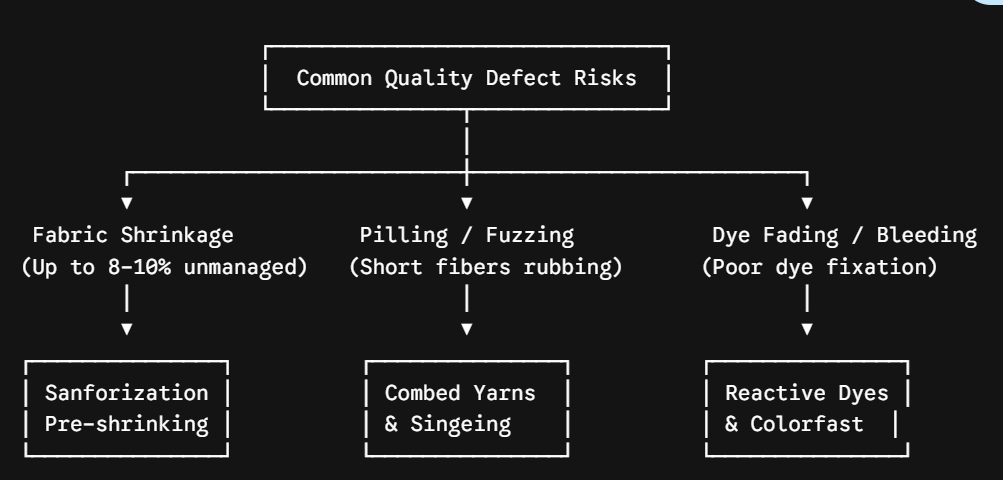
Risk 1: Excessive Fabric Shrinkage
Unprocessed bamboo and lightweight cotton fabrics can shrink up to 8–10% after home washing.
- Factory Defense: Ensure your manufacturer applies a mechanical Sanforization (pre-shrinking) process and adds dimensional stability allowances to cutting patterns.
Risk 2: Fabric Pilling and Fuzzing
Friction causes short staple fibers to break and entangle into small pills, particularly on low-grade bamboo yarns.
- Factory Defense: Specify singed yarns and tight weave constructions (such as 300TC–400TC sateen). Request pilling test results (ISO 12945-2) exceeding Grade 4.
Pro Tip for Sourcing Executives: Always request a Pre-Production Sample (PPS) accompanied by third-party wash test reports before approving mass production deposits.
Conclusion & Actionable Next Steps
Whether you choose the silky softness of Bamboo, the eco-engineering of Tencel, or the proven resilience of Long-Staple Cotton, aligned manufacturing parameters are essential to your brand’s market success.
Ready to Upgrade Your Bedding Line?
Contact Our Sourcing Engineering Team Today to request physical fabric swatch books, custom OEM catalogs, and direct factory FOB pricing for your upcoming collection.